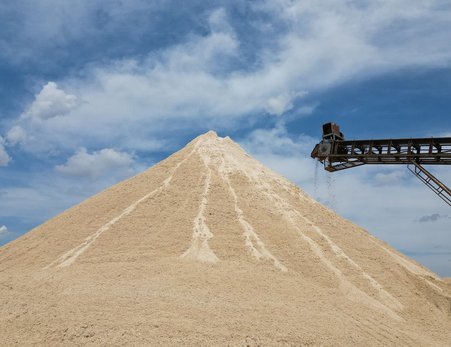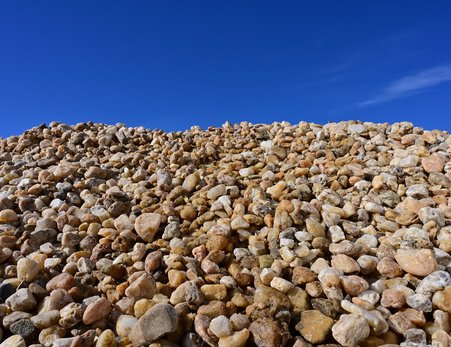

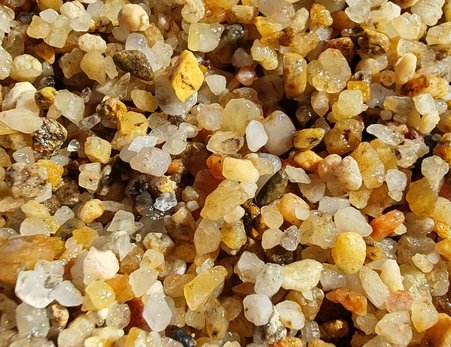
Quartz sand (silica sand) is a natural sand consisting mostly of silicon dioxide (SiO₂). We supply quartz sand obtained from natural deposits, screened without crushing and dried with hot air at no more than 120 °C, in six fractions between 0.1 and 5 mm. The SiO₂ content of the fractions is about 90%; the chemical analysis of each fraction is given in the table below.
Technical specifications
- Material
- Natural quartz sand; grains are screened without crushing
- Drying
- Dried with hot air at max. 120 °C
- Colour
- Yellowish beige, natural sand tone
- Hardness
- 7 mohs (quartz)
- SiO₂ content
- 89.6 – 91.5 % (by fraction, see table below)
- Other oxides
- TiO₂ 0.03 – 0.09 % · CaO 0.14 – 0.30 % · MgO 0.02 – 0.07 % · Loss on ignition 0.22 – 0.32 %
- Analysis
- Test reports from an accredited laboratory (TS EN ISO 17025), 2023. Values refer to the tested sample and may vary from lot to lot.
- Packaging
- 25 – 50 kg kraft bags; 1.5 t big bags; bulk truck delivery
- Custom fraction
- Other grain ranges can be screened on request
Fractions and chemical analysis (%)
| Fraction (mm) | SiO₂ | Al₂O₃ | Fe₂O₃ | Na₂O | K₂O |
|---|---|---|---|---|---|
| 0.1 – 0.5 | 90.02 | 5.50 | 0.381 | 1.29 | 2.07 |
| 0.5 – 1.0 | 90.41 | 5.30 | 0.339 | 1.19 | 2.20 |
| 0.8 – 1.5 | 91.52 | 4.67 | 0.204 | 0.87 | 2.25 |
| 1.5 – 2.5 | 89.62 | 5.64 | 0.456 | 1.37 | 2.30 |
| 2.0 – 3.0 | 89.56 | 5.76 | 0.453 | 1.42 | 2.27 |
| 3.0 – 5.0 | 90.07 | 5.42 | 0.566 | 1.33 | 2.01 |
Applications
- Water treatment and sand filters
- Pool and spa filters
- Filler and broadcast sand for epoxy floor coatings
- Cement, mortar and ready-mixed construction chemicals
- Ceramics, glass, porcelain and refractory production
- Foundry sand
- Infill for artificial turf and sports surfaces
- Polymer and composite fillers
- Landscaping and decorative applications
Advantages
- Six standard fractions from 0.1 to 5 mm, custom screening on request
- Chemical analysis from an accredited laboratory for each fraction
- Dried and ready to ship in bags or big bags
- Bag, big bag and bulk delivery options
Which fraction should I choose?
The right fraction depends on where the sand will be used. The grouping below is a general starting point; follow the project specification or the equipment manufacturer's recommendation where there is one.
- Fine fractions (0.1 – 0.5 and 0.5 – 1 mm): epoxy and mortar filler, construction chemicals, foundry sand, ceramic and glass raw material.
- Medium fractions (0.8 – 1.5 and 1.5 – 2.5 mm): sand filter beds, pool filters, broadcast sand on epoxy floors, sports surfaces.
- Coarse fractions (2 – 3 and 3 – 5 mm): support layers in filters, landscaping and decorative uses.
Can quartz sand be used for blasting?
Quartz sand contains a high proportion of crystalline silica. During blasting the grains break down and form respirable silica dust, which carries a risk of silicosis. For this reason we do not sell quartz sand for blasting. For surface preparation we recommend abrasives such as garnet, aluminium oxide or steel grit.
We do not recommend quartz sand as a blasting abrasive: the free crystalline silica in the dust generated during blasting carries a risk of silicosis. For blasting work, see our abrasives such as garnet, aluminium oxide or steel grit.